Turn insights into smarter operations
Get startedShare
4 min read
May 8, 2026
Turn your bar into the revenue engine it was always meant to be
The bar is one of the biggest revenue drivers at any event, and also where margin disappears without leaving a trail. Cash variances, untracked inventory, slow card runs, and zero visibility into what's actually being poured are symptoms of one specific operational problem: a bar that runs disconnected from the rest of the business. This article breaks down which numbers you should be reading in real time and how a POS integrated with pre-sales, access control, and CRM changes the margin equation.
Why the bar is still the blind spot of nightclub operations
Most clubs and festivals have a clean read on advance sales. They know how many tickets went out, at what price, and through which channel. But the moment doors open, the bar runs on a parallel system. With no link to access control, no cross-reference with pre-sale data or the CRM, what gets consumed during the event is essentially invisible until the closing report drops at 4 a.m.
The outcome is always the same: decisions made on gut feel and cash variances no one can explain. Running the bar at a festival or a club with a generic restaurant POS isn't a tool problem. It's a design problem. Those systems weren't built for the speed or the integration your operation actually needs.
The cash issues that look human but are actually operational
When the bar comes up short at close, the first instinct is to look for the bartender who miscounted. Most of the time, the root cause is operational.
Without bartender-level traceability, the variance shows up as a single line on the closing report with no way to trace it. Without integrated payments, manual entry on the card reader compounds errors with every round. Without real-time inventory, you find out a SKU ran out when a bartender flags it, not when the system does. With a slow or poorly configured POS, every extra second per transaction kills the next round before it gets ordered. And without integration between the POS and the CRM, consumption data stays in the accounting column and never becomes business intelligence.
Bottle service orders shouldn't depend on a bartender's memory
In VIP areas and table service, the traditional model puts the server on a round trip: take the order at the table, walk it back to the bar, repeat it verbally, return with the bottle. No order record, no link to the reservation, and a wide margin for both error and lost time, exactly when the spend per table is highest.
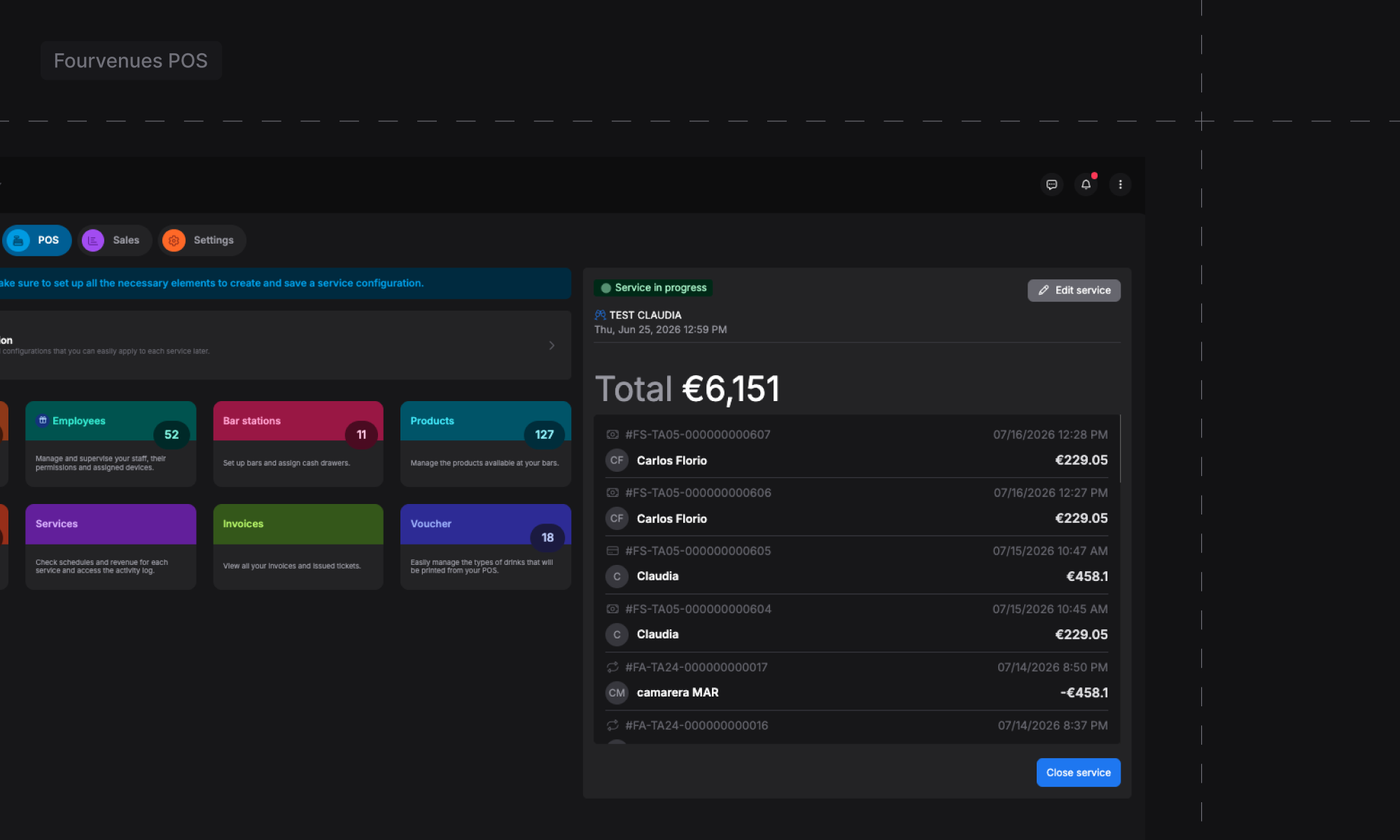
With the order system on the Fourvenues POS, the server places the order from the table and it lands at the bar automatically. The impact is direct: the bar gets the order the moment it's fired, every ticket is tied to its corresponding VIP reservation, and the spend per guest is logged in the system, cross-referenced against their history in the CRM. In a club with active bottle service, this flow is a direct lever on average check and operational control.
Real-time visibility: decisions during the event, not the morning after
With the Fourvenues POS connected across your operation, you have live access to revenue per bar, sales per bartender, spend on every table reservation, and pre-paid drink redemptions. If a table has already consumed everything that was pre-arranged, you can keep driving the upsell. If consumption in one room doesn't match the actual headcount from access control, you have the data to act on it in real time, not in next week's review.
These are the questions your system should answer while the event is still running:
- How much have I rung up at each bar right now?
- How much is each VIP table consuming?
- Are the drinks sold in pre-sale actually being redeemed?
- Which bartender is pulling the highest and lowest sales this shift?
- Which SKUs are about to run out?
A POS that doesn't answer these in real time wasn't designed for your operation.
The margin lives in the details you're not measuring
When the POS is integrated with ticketing, access control, and the CRM, every bar transaction stops being a line on the books and becomes a data point about your guest. With that history you can segment, run targeted campaigns, and make pricing calls with real criteria behind them. That's the difference between operating with a payment tool and operating with a system.
Optimize your bar operation with Fourvenues and turn every night into information that works for you.
Is your bar generating data or just processing tabs? Connect your full operation and take control of every night with Fourvenues.
Request information